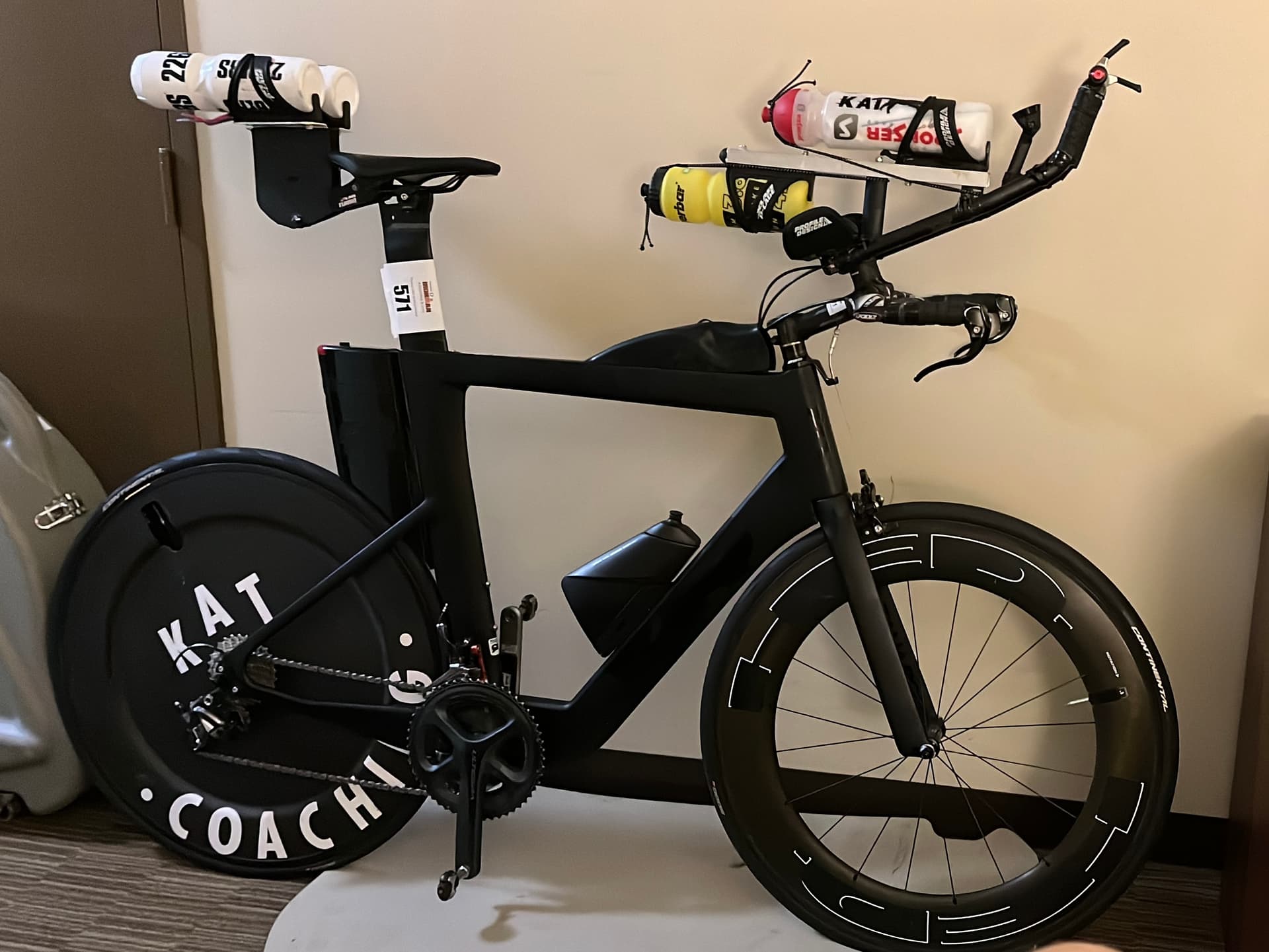
I am a decently fast cyclist (4:36 at AZ IM a few weeks ago).
Riding a 2018 QR PR5 frame which I set up with the groupset from my previous bike, so I am on a roughly 2012 Shimano Ultegra 11 speed mechanical groupset with a Stages powermeter.
Zombie rigged a few items for aero gains from aluminum parts I had in the shop.
You get the idea - not a ton of money here…especially now that I forked out 2.6k (in CAD dollars) to sign up for Kona 2026.
For that race I need to find another 6 minutes. Do I need electronic shifting? Mostly to get rid of the cables (both for aero reasons and for ease of packing) and to get rid of the hideous bar end shifters; it is also definitely going to make me faster, right?
Options I see are:
Stay with Shimano → 12 speed cassette should fit my 11 speed hub body, so only need shifters, derailleurs, battery, cassette and chain but have not gotten rid of the cables…
Change to SRAM entirely → Need everything, including a crankset with power meter; unsure about converting free hub bodies for my disc wheel (Flo), HED rear (for Kona) and training wheel. Could go with 1x to save some $$s.
Stay with the theme of the bike and zombie it → 12 speed shimano cassette, keep the crankset/chainring as is, buy SRAM chain and derailleurs, supposedly that will work? Would have to go with RED in front because I need that 53 chainring.
Or accept that I will be on the most antique bike in Kona and enjoy passing people on 15k bikes as I usually do…until they re-pass me on the run (but that is another story).
You only need SRAM AXS 12x rear and front derailleurs (for the front a Red or Force one in order to stay with the 53 ring) wireless blibs, a Shimano 12x cassette and a Shimano 12x chain.
Electronic shifting won’t gain you any speed. It’s good stuff, but even after using it for years now, I think it’s far over-rated for what it actually does. Definitely did NOT make me any faster, on road nor TT bike, and as nice as it is to shift from the drops as well, I sometimes miss that satisfying ‘clunk’ of manual shifting that really puts you in tune with your bike.
I agree; it won’t give anyone six minutes, but I think folks tend to underestimate the advantage. It’s much easier to shift and with electronic shifting people tend to shift more often and stay in a better gear. This is more obvious when riding out of the saddle (with only end-of-aerobar shifters available with manual groupos), but even in aero people shift more.
+1 Fully agree with all the above. I swapped from a way older bike than yours to latest SC with Di2 last year. Being able to shift from basebar is only advantage to a well tuned 10 (or 11) speed ultegra setup.
Disadvantage with Di2 is syncroshift (still don’t like) which you don’t have with SRAM. You also have the need still to have wires albeit thinner that again SRAM wins.
If you’re riding 4:36 then you know how to change hears and put the power down efficiently. So the benefits on changing more will be less for you than further down the field.
Spend the money on an (extra) fortnightly massage or better nutrition (general, not raceday) and the recovery improvement may get you the 6 mins.
All the above is based on 100% evidence backed subjective personal opinion from a semi anonymous internet poster. So consider that when making a decision.
It’s a hobby. People enjoying it is what it IS all about. Either choosing and riding a flash bike at whatever their pace, fast or slow, or an older model/cheaper model fast or slow. If someone is out there having fun - awesome, you are a winner. If you’re moaning that slow people shouldn’t buy expensive bikes (which to be clear you are not) then they should keep schtum. Other than that, no harm no foul.
I definitely got a bit of extra motivation for all the years my bike cost less than most single wheels I went past. And now I get the motivation from fear of being past by some young kid on a steel roadbike with clip-ons. .
I did an 11 speed used from ebay upgrade on my old tri bike. Hate to admit, but it shifts better than my new(er) Canyon 11 speed with the same components.
Depends a bit on which other races, I’m going through same decision process….and a lot slower than you on the bike. Based on your kinds of performances with a 4.36 I’d presume a 1X system is very doable, so you save a bit of cash and it’s likely less to go wrong and maintain; I’m also in the camp of Di2/AXS not really making you faster well not 6min faster, but you might have marginally better gear selection and a 12 speed cassette for Kona type conditions means you probably can go 1X more easily e.g. SRAM 10-33 or 10-36 and never have an issue anywhere on course other than maybe one shunt up Palani which is just a tiny section.
Not really any point to go mechanical 12 speed, if you have a desire to shift do it to electronic; there are a few other options but if in USA might not be viable eg wheelstop I think the brand is, very popular now in Asia and can set up to run 11 speed but seems like you want to shift to 12.
If 12 1X, then there are some universal 1X chainrings e.g. rotor etc that can run a zombie set up with a sram cassette and a non sram chain, or sram chain sram cassette universal or sram compatible 1X at the front. The big complaint for Sram seems to be mostly the FD not the RD, so 1x solve some of that. And slower shifting which supposedly has improved. The biggest complaint for me and why will never use Di2 shimano again until they solve the wireless, is damage to the wires in the system resulting in 3 races where the gears stopped working and took hours of fault finding to find which one, replace it - 2X was shifted bike parts in the case in transit cannot stop that issue; SRAM eliminates this, 1X also eliminates one more part to go wrong.
There is an apex xplr 11-44 casette you can run with shimano hub and maybe a couple of after markets, you can also do the zombie shimano 12 speed cassette, universal chain ring and shimano compatible chain with sram RD, people seem to be able to make it work. But then you need probably bigger than 53 at the front, 1X is even numbers AFAIK, so that’s 54, a 54 with a shimano cassette or even better XDR hub and a 10-XX cassette at the back is how I plan to set up.
QR P5 isn’t the most antique bike for sure. still nearly there. Presume you have no issues with rim brakes; but at least here anything rim (my preference actually over disk brakes again due to the potential for nightmares) is utterly worthless and hard to sell now similar to 11 speed as well now - so at some point have to decide how much you can handle putting more money in a ride - I’d say there is minimal benefit from the frame and rim/disk brake decision - instead it would be a more modern scoop style cockpit which reduces the fatigue in your shoulders and maybe allows you a slightly better position (although guessing you have already fiddled that e.g. tririg sigma monopost set up with an adapter plate + scoops + tririg aero brake on the front that would probably make more difference than the gearing.
My set up is value engineered to the max:
rotor 54 qring + existing 165 cranks: IMHO crank length is a gain
10-36 cassette sram force + sram force chain + XDR hub
11-44 apex for training wheel for mountains and can use existing hub
rival XPLR RD + 1 battery (2 spares not Sram branded + charger) (you are stronger you don’t need this)
4 wireless blips no junction box, no wiring, here in Asia people already figured out how to open and replace batteries; LEAP component blip cases
assioma shimano power pedal left side only
tririg alpha cockpit, but you could use the new sigma stem system and combine with your existing parts potentially or find some other cockpit brand, the one from vision is not bad metron a bit cheaper or just change out the cups to scoops on what you have now
new bike is disk brake; will run mechanical TRP Spyre (not hydraulic) disk brakes; again to eliminate the risk of the bike not working; I arrived in Kona with a non working bike, it took 3 days to get it running again (di2, lost cockpit part in transit); adding brake or tubeless failure….I swear already eough, I’d rather be a fraction slower and not have the stress; that’s almost a case for sticking with mechanical, and invest in cockpit improvements, helmet and a few massages
My only problem is I suck. If I didn’t suck this set up would be pretty golden! Sram is a lot cheaper when set up this way vs. Shimano, at least from what i purchased.
I’ve been debating the same thing - I’ve got a 2013 Shiv S-works tri bike, and it’s just about as fully upgraded as you can get while still using mechanical shifting. Ultimately, I’ve decided it’s a no for me on upgrading to 12 speed wireless shifting, at least until I’m forced to. The watts/$ ratio just isn’t there. Besides having to get all the usual equipment, I would also need to switch the rear wheel hubs and also get a new trainer (V1 Wahoo Kickr will not work with 12 speed cassette). And then would have to upgrade the front end to an integrated pad/aerobar setup in order to reap more than 1 watt or so from the whole change.
Here is an alternative idea to gaining some speed, because I know you have to go into a new season with some kind of improvement: switch to 1x and a large (56 or bigger) aero chainring. It doesn’t just look cool, it really saves watts. 2-4 W from the aero advantage of going to 1x (removing front derailleur) and a chainring with a lenticular shape, and then another 2-4 for the gear ratios. A 58-14 is significantly faster than the equivalent gear ratio for a 53. Probably 53-12 without doing the math. A good aero chainring is around $200-300, you can sell your front derailleur and end up not spending much money for real watt savings.
As above, I’m more than happy with mechanical, on have DI2 on one of the 11 bikes in the fleet. And I have ridden every IM I’ve raced with spare gear and brake cables in my tool kit. However, I would suggest that in practical terms, there’s no difference in race for 95% of triathletes, if something goes wrong then you’re poked - mechanical or electronic. I’ve had a mechanical rear mech snap at the parallel plates, and a rear dropout snap, both electronic and both taxi call inducing moments.
Where I think your point would be more accurate, is that if something goes wrong on the way to a race, or even race day morning, there’s a lot better chance you can sort it quickly and at any bike shop/on site mechanic with mechanical, electronic may need parts not stocked locally, and you have less options of botching a fix that is servicable with what they have on the shelf in terms of mechs/cables/ shifters.
Was your eBay groupset Shimano or Sram?
I’ve looked a little bit into making this switch but haven’t seen any that were rim brake setups, which I would need for my old Slice
I have trp source on my tt bike and hydraulic 105 on my roadie.
Trp disc is fine works about as well as a good rim Brake but hydraulics really shine on hard braking or steep descents.
On a windy hill descent in my area I go nearly 3 mins faster on a 15 min descent with hydraulic disc vs my old rim brakes. Trps are in between. Was surprised how much speed gain I got from a brake upgrade on a windy steep descent. Also made me realize that my buddies who I thought were descending monsters when I was on rim, actually just had disc brakes compared to me which was why they were so much faster downhill.
A benefit of electronic shifting is that you get shifters on the base bar grips, not only on the aero bars. Mostly on hilly training rides and racing that is a strong benefit on safety, as you dont need to move your hands from the base bar (say during a climb) to the aero shifters, while shifting.