ITT
People who originally said the new system was great! Now upset because their age group isn’t at the top of the qualifiers 
ITT
People who originally said the new system was great! Now upset because their age group isn’t at the top of the qualifiers
Which is why it’s not a direct goal of the new system. He’s established a system that’s irrelevant of gender for Kona and made it performance based. That way if they do grow the appeal for women they only have to be fast and not feel disenfranchised by a system that puts them at a disadvantage due to small relative size. In that sense they work together while having separate goals.
But the consistency isn’t in the number of slots - the consistency is in what time you need to hit for each age group.
Once this all settles down, we’ll have a good idea of what an age graded time is needed to hit the KQ. Say for example, that after a few races, we now understand that you need a 9:15 age/gender graded score to KQ.
Great! Now you know what you need to hit in every age group. No lottery, no randomness. Just hit a 9:15 equivalent and you’re in.
Why does it matter if there’s more or fewer from a particularly gender or age group? All I care about as a KQ aspirant is hitting 9:15.
I suspect that you’re still thinking about this in terms of proportional allocation? You need a certain number of representatives from each race, or something similar? But in reality, if we’re rewarding athletic performance, there’s going to be variation across races.
But if I’m a KQ aspirant, it’s easy, just hit my time.
Only in so far as you don’t want a disproportional cohort of older participants, that would not be good for the sport long term. But as Taylor Knibb is fond of saying, we’ll see.
I do, I think we can’t completely disregard that.
I think you are getting caught up in social engineering at any particular race, whereas on a global scale, this will all shake out because it is based on the global top 20 percent over five years of championships, so that rough density will all shake out over a year of qualifying. We will have per race differences, but overall what we should see is that the 21-100th percentage participants at worlds across age groups will be tighter because less mega rolldown receipients get in.
The previous issue with the roll down was NOT the back half of the larger age group slot takers were marginally too slow.
That’s nonsense, whether it’s true or not. You don’t redesign the system which was predictable and understandable by everyone because you’re worried there might be 1 extra slow 28 year old and 2 extra slow 40 year olds, and not enough fast 55 year olds. NO ONE was talking about that being a problem.
Let’s remember they resigned the system on the heals of a failed attempt at gender equal slot distributions with a split race. That concept failed, largely because not enough women race enough to be bothered to turn up in equal numbers to a world championship.
With that unsustainable failure in mind, IM wanted to find a way to make an age adjusted performance allocation that should allow more women to qualify.
However, what they didn’t realize is that in putting men vs women in the rankings, certain areas and certain courses are likely to favor men more than the average distribution they were going for.
It seems insane to say “we want to qualify a majority of our women for Kona from the North America because they fair better relative to the men than Euro women do.”
Likewise, the results are having quirky effects in age groups for both genders.
Remember, this assignment was rolled out after they needed a away to go back from a 50/50 slot allocation. And they can say they were looking at it before, but only because the misguided goal of presuming they could use long distance Kona to get more women into long course triathlon. That goal already failed with the split races and it looks to be failing again with this jiggery slot distribution.
Does anyone think this new slot allocation will last longer than the split world champs did? I don’t.
And here’s where it’s interesting. Ironman has alleged that part of the main driver for this change is to get faster performers in Hawaii. If so, why not just start with the fastest times and work their way down?
Why the statistical weighting? Because they recognize that fastest time standard would disadvantage the other age groups and genders. Well? This new system seems to be just another way to disadvantage other age groups and genders.
The old system wasn’t perfect but it was better in most ways. The new system has the appearance of being great, but clearly in practice it is going to turn off large groups of customers.
100%, that’s what I am feeling as well. Anyway, we have a dedicated thread for debating that, I haven’t been able to find the Copenhagen graded scoring yet this morning.
so are you saying its not fair if the better females get more slots ?
ie its well known American males are not really that competitive.
Abracadabra:
https://cdn-1.sportstats.one/rolldown/IRONMAN%20Copenhagen_IRONMAN.html
(just replaced “Kalmar” with “Copenhagen” in @devashish_paul 's Saturday link)
15 women in the 40 slots available - of course depends on take up)
| Slot | Rank | Name | Division | Div Rank | Race Time | Age Graded Time |
|---|---|---|---|---|---|---|
| 1 | 11 | Caroline Nowak | F18-24 | 1 | 09:35:22 | 08:12:55 |
| 2 | 16 | Michelle Andersen | F25-29 | 1 | 09:15:23 | 08:17:41 |
| 3 | 3 | Natasha Harris-White | F30-34 | 1 | 09:02:14 | 08:06:46 |
| 4 | 27 | Camilla Zaage | F35-39 | 1 | 09:28:48 | 08:24:18 |
| 5 | 20 | Satu Suuronen | F40-44 | 1 | 09:34:10 | 08:19:55 |
| 6 | 22 | Bozena Jaskowska | F45-49 | 1 | 09:49:17 | 08:20:57 |
| 7 | 34 | Trine Brask | F50-54 | 1 | 10:23:48 | 08:26:50 |
| 8 | 6 | Patrick Decastille | F55-59 | 1 | 10:29:14 | 08:09:25 |
| 9 | 5 | Tuula Perkiö | F60-64 | 1 | 11:16:38 | 08:08:24 |
| 10 | 15 | Tobias Marinussen | M18-24 | 1 | 08:31:39 | 08:16:11 |
| 11 | 1 | Frederik Holm Wester | M25-29 | 1 | 07:49:10 | 07:45:27 |
| 12 | 25 | Nikolaj Koors Hoff | M30-34 | 1 | 08:23:11 | 08:23:11 |
| 13 | 45 | Adam Labbett | M35-39 | 1 | 08:36:05 | 08:30:40 |
| 14 | 24 | Dennis Steffensen | M40-44 | 1 | 08:38:55 | 08:22:28 |
| 15 | 17 | Tom D’Hoossche | M45-49 | 1 | 08:50:16 | 08:18:30 |
| 16 | 30 | Arto Helovuo | M50-54 | 1 | 09:21:23 | 08:25:21 |
| 17 | 2 | Per Nilsson | M55-59 | 1 | 09:16:16 | 08:02:07 |
| 18 | 4 | Claus Leinøe | M60-64 | 1 | 09:49:43 | 08:07:14 |
| 19 | 12 | Klaus Haller | M65-69 | 1 | 10:55:21 | 08:14:55 |
| 20 | 89 | Gerard Turbitt | M70-74 | 1 | 12:42:04 | 08:44:00 |
| 21 | 7 | Camilla Lykke | F30-34 | 2 | 09:05:39 | 08:09:49 |
| 22 | 8 | José Rui Galvao | M55-59 | 2 | 09:25:14 | 08:09:54 |
| 23 | 9 | Shawnie Lovatt | F30-34 | 3 | 09:06:50 | 08:10:54 |
| 24 | 10 | Caroline Corfitzen | F30-34 | 4 | 09:09:00 | 08:12:50 |
| 25 | 13 | Sebastian Schatz | M25-29 | 2 | 08:19:04 | 08:15:08 |
| 26 | 14 | Klaus Halloe | M55-59 | 3 | 09:32:23 | 08:16:05 |
| 27 | 18 | Christoph Ibold | M65-69 | 2 | 11:00:29 | 08:18:48 |
| 28 | 19 | Michael Neergaard Hoegh | M45-49 | 2 | 08:51:34 | 08:19:43 |
| 29 | 21 | Mathias Lorenzen | M25-29 | 3 | 08:24:55 | 08:20:55 |
| 30 | 23 | René Poppe | M55-59 | 4 | 09:38:25 | 08:21:19 |
| 31 | 26 | Ronald Lehmann | M30-34 | 2 | 08:24:01 | 08:24:01 |
| 32 | 28 | David Mantle | M55-59 | 5 | 09:41:53 | 08:24:19 |
| 33 | 29 | Simon Nymann Andersen | M25-29 | 4 | 08:28:57 | 08:24:55 |
| 34 | 31 | Jan Wolff | M45-49 | 3 | 08:57:33 | 08:25:21 |
| 35 | 32 | Viktor Bertin | M18-24 | 2 | 08:41:30 | 08:25:45 |
| 36 | 33 | Laura Valgreen | F25-29 | 2 | 09:25:04 | 08:26:21 |
| 37 | 35 | Torben Foged | M55-59 | 6 | 09:44:52 | 08:26:54 |
| 38 | 36 | Christian Boutrup | M18-24 | 3 | 08:42:44 | 08:26:57 |
| 39 | 37 | Lærke Schjødt Rasmussen | F30-34 | 5 | 09:24:55 | 08:27:08 |
| 40 | 38 | Julia Enevoldsen | F18-24 | 2 | 09:52:39 | 08:27:43 |
| 39 | Joachim Reitan | M55-59 | 7 | 09:45:50 | 08:27:45 | |
| 40 | Karlien Claus | F25-29 | 3 | 09:27:07 | 08:28:12 | |
| 41 | Ruta Juskeviciute | F30-34 | 6 | 09:26:16 | 08:28:20 | |
| 42 | Michael Hopp | M50-54 | 2 | 09:25:14 | 08:28:50 | |
| 43 | Steffen Værens | M40-44 | 2 | 08:45:42 | 08:29:03 | |
| 44 | William Fuglsbjerg | M18-24 | 4 | 08:45:08 | 08:29:16 | |
| 46 | Casper Stenderup | M30-34 | 3 | 08:31:07 | 08:31:07 | |
| 47 | Kevin Andersen | M18-24 | 5 | 08:47:15 | 08:31:20 | |
| 48 | Finn Nugent | M30-34 | 4 | 08:31:29 | 08:31:29 | |
| 49 | James Green | M30-34 | 5 | 08:32:02 | 08:32:02 | |
| 50 | Emil Skræm | M18-24 | 6 | 08:49:00 | 08:33:02 |
Better showing for the women. Still if I’m reading it right, 7 slots went to M55-59. 6 to M18-24 and F30-34, that’s good to see. For me if I am going to see a bias, I prefer it to be towards the younger AG’s both male and female. I’m looking at the top 50 to compare apples to apples.
Slot # 8… F55-59 Name : Patrick Decastille. Did he take his slot 
Need to count only top 40, so only 3 to M18-24 and 5 to F30-34.
I mean, M30 and M40 doing around 8.30-8.45 of real time is still bonkers to me.
Don’t blame the monkey: blame the data.
Patrick certainly identified as a chap a couple of years ago.
Guess actual top F55-59 was/is:
137 Shona Hughes F55-59 2 11:27:27 08:54:42
While we’re “there” I note the AG best was Frederik Holm Wester in 7:49 which would have gained him #13 in the MPRO field - <8% down on the excellent Grosse-Freese.
| AG | Number |
|---|---|
| F18-24 | 27 |
| F25-29 | 90 |
| F30-34 | 86 |
| F35-39 | 39 |
| F40-44 | 41 |
| F45-49 | 77 |
| F50-54 | 53 |
| F55-59 | 24 |
| F60-64 | 8 |
| F65-69 | 2 |
| M18-24 | 201 |
| M25-29 | 392 |
| M30-34 | 311 |
| M35-39 | 242 |
| M40-44 | 209 |
| M45-49 | 200 |
| M50-54 | 200 |
| M55-59 | 117 |
| M60-64 | 62 |
| M65-69 | 14 |
| M70-74 | 2 |
| M75-79 | 0 |
| Total | 2397 |
| Total W | 447 |
| Total M | 1950 |
In the top 50 I see 28 people under 40
In the top 50 I see 18 women
We probably need to count up to 60 to have a feel for who has a chance at rolldown so this race appears to be biasing towards more young athletes performing and a solid number of women up there. Races like this even out other races where you may see more older men in the performance pool
But here we need to evaluate the system, not the potential rolldown.
With the system we have the 7th, 8th and 10th overall, which did an 8.31 not getting a slot. It is absolutely nonsense, however we put it.
I think we’re all getting ahead of ourselves - There’s going to be variability race to race - that’s how statistics works!
I don’t think we can go through a whole season and saying 'this race let in too many F65s while this race let in too many M25s" and derive any kind of statistical significance from it.
To figure out if this is a good system, we either need to take a step back and apply the coefficients to the past few years and see what the distribution would have been (but this takes actual work - any takers?) or we need to wait and see who shows up to Kona.
There is far too much variability race to race to make judgements based on a single race, or even a few races - especially if we’re just eyeballing the results sheet.
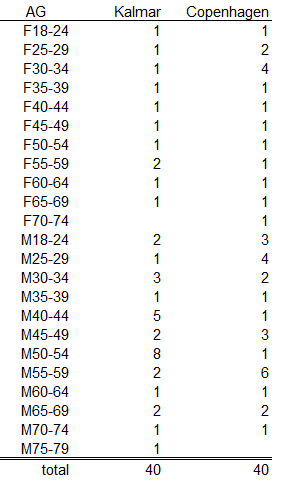
Assuming all age groups winners take their slots and no roll-down I come to this overview. 22 Different age groups are present at both races, so 22 of the 40 slots are already taken. This means 18 slots remain for the general population so you simply go down the list, excluding the age group winners, until you reach 18. Interesting to see that there are some very fast M50-54 triathletes in Kalmar while in Copenhagen only the winner directly qualifies in this AG.
Mental time. It seems 2 years ago he was an hour slower so even more insane that progress at this level.
Thank you for posting this. This chart proves exactly my point.
Here we have 2 races, a day apart. I don’t know if the conditions were any different, but i have to assume the athlete pools were similar. Both Europe, and both Scandinavian countries.
And yet we get very different results.
We need to either do the math or wait until Kona before we make any conclusions.